
Demand and Activity Analysis as a Tool for Autistic Burnout
Demand and activity analysis is one of the most foundational skills in occupational therapy. We use it all the time - to understand what a task truly requires of a client, to identify where the gap is between those demands and their current capacity, and to shape our intervention planning accordingly.
But what if we gave it to them?
In occupational therapy, activity analysis is how we break down the tasks that make up a person's daily life - looking at what each one actually requires physically, cognitively, socially, and environmentally. We use it to understand where things are breaking down for a client and to shape how we intervene. It lives, traditionally, on an OT’s side of the clinical relationship.
After spending time pulling from adjacent research and a few years of practice with this population, I've found it's beneficial to adapt it a bit - using activity and demand analysis not just as a clinical tool, but as a skill I actively teach clients to apply to their own lives.
This approach works. And it works because it makes visible what was always there - the hidden demands that were quietly draining people long before burnout arrived.
How to Use Demand and Activity Analysis for Autistic Burnout Recovery
Occupational analysis and energy management play vital roles in both recovering from and preventing autistic burnout. These practices help individuals gain insight into what energizes or depletes them - and with that insight, they can begin to adjust their habits and routines toward better balance.
In my practice, this starts during the evaluation. I conduct structured interviews to develop a thorough occupational profile: an understanding of the client's daily living patterns, roles, and routines. Where is their time and energy actually going? What does a typical day look like, and what does it cost them?
From there, we move into demand analysis - examining the specific elements required to carry out their daily activities. This is where the OT framework becomes something most clients have never experienced before: someone helping them look at their life not through a productivity lens, but through a demands and capacity lens.
The demand categories I focus on with this population include:
Space and sensory demands: The physical environment of an occupation - lighting, noise, crowds, temperature - and how those sensory factors affect processing and regulation.
Social demands: The social norms, expectations, and interaction patterns involved in an activity, including how much masking they require.
Sequencing and timing demands: The transitions and timing involved with the activity.
Physiological demands: Executive functioning demands - planning, decision-making, cognitive flexibility - as well as sensory processing demands specific to the task.
This analysis is grounded in the AOTA Occupational Therapy Practice Framework (2020) and informed by research on autistic burnout, sensory processing, and energy management (Bertilsdotter Rosqvist, 2019; Higgins et al., 2021; Mantzalas et al., 2021; Schoondermark et al., 2024). What is original here is not any single piece of that research - it is the way these elements are brought together and applied specifically to autistic burnout intervention through an occupational therapy lens.
The Shift: Teaching Clients to Use the Tool Themselves
While OTs generally use demand and activity analysis to guide our own clinical reasoning, I have found that it is also one of the most powerful skills we can teach clients to use themselves. When clients learn to break down the demands of their daily activities - with their own sensory profile, social needs, and energy patterns in mind - they start to understand what is depleting them in ways they never could before.
They stop wondering why they are so tired. They start seeing exactly what has been asking so much of them.
A Concrete Example
A client might come in exhausted after attending an old friend's birthday party - confused, because it was someone they genuinely care about and wanted to celebrate. But when we walk through the demand analysis together, the picture becomes clear:
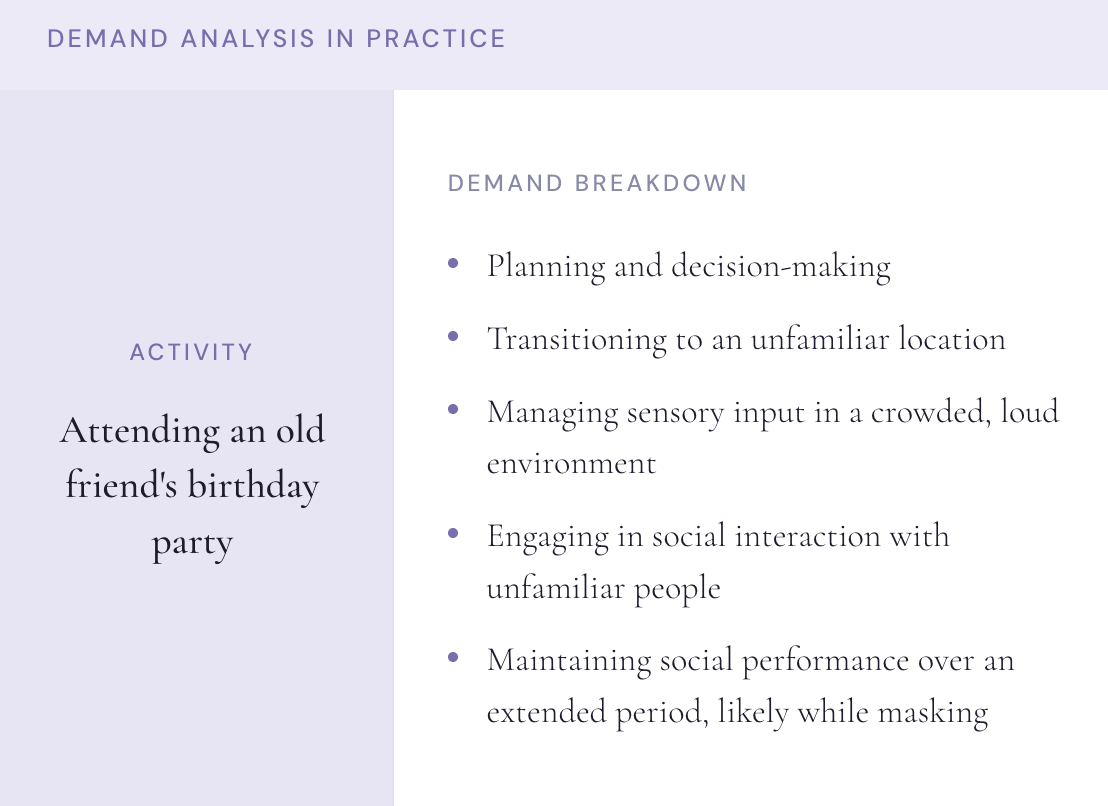
Planning, decision-making, transitioning, managing a stimulating environment, sustaining social interaction with people they don't know well - each of these is a real demand. For this population, they are particularly costly. Together, they explain an exhaustion that has a completely logical source.
When clients can see this clearly, something shifts. They are no longer confused by their own experience. They have a framework. And with that framework, they can start making more informed decisions - about which activities are worth the cost, how to adapt the ones they want to keep, and how to protect their energy before burnout takes hold rather than after.
A note on this work: The approach described here was developed through clinical practice beginning in 2024. It is not a formalized framework - it is a clinical perspective built by synthesizing adjacent research that had not previously been connected in this way for autistic burnout.
References
American Occupational Therapy Association. (2020). Occupational therapy practice framework: Domain and process (4th ed.). American Journal of Occupational Therapy, 74(Suppl. 2), 7412410010. https://doi.org/10.5014/ajot.2020.74S2001
Bertilsdotter Rosqvist, H. (2019). Doing things together: Exploring meanings of different forms of sociality among autistic people in an autistic work space. Alter: European Journal of Disability Research, 13(3), 168-178. https://doi.org/10.1016/j.alter.2019.03.003
Higgins, J. M., Arnold, S. R., Weise, J., Pellicano, E., & Trollor, J. N. (2021). Defining autistic burnout through experts by lived experience: Grounded Delphi method investigating #AutisticBurnout. Autism, 25(8), 2356-2369. https://doi.org/10.1177/13623613211019858
Mantzalas, J., et al. (2021). What is autistic burnout? A thematic analysis of posts on two online platforms. Autism in Adulthood, 4(1), 52-65.
Raymaker, D. M., Teo, A. R., Steckler, N. A., Lentz, B., Scharer, M., Delos Santos, A., Kapp, S. K., Hunter, M., Joyce, A., & Nicolaidis, C. (2020). "Having All of Your Internal Resources Exhausted Beyond Measure and Being Left with No Clean-Up Crew": Defining Autistic Burnout. Autism in adulthood : challenges and management, 2(2), 132–143.https://doi.org/10.1089/aut.2019.0079
Schoondermark, F., Spek, A., & Kiep, M. (2024). Evaluating an autistic burnout measurement in women. Journal of Autism and Developmental Disorders. https://doi.org/10.1007/s10803-024-06438-8
© 2026 Melanie Inouye, OTD, OTR/L · Please do not reproduce without permission.